No Rabbit in a Hat, but Steve Cohen Has Magic Up His Sleeve
By N. R. Kleinfield Published: March 3, 2010
Steve Cohen, who directs his sleight of hand and other tricks for the upper crust, performs as the Millionaires’ Magician.
In the article from this past Sunday's New York Times, Steve talks about his career and his start at Tannen's Magic Camp as well as a recent visit to the shop.
"For four summers, starting when he was 12, he attended Tannen’s Magic Camp on Long Island. A fellow camper was David Blaine and his counselor was Johnny Ace Palmer, a skilled close-up magician. While in high school, Mr. Cohen got $20 an hour to walk around doing magic at a local restaurant."
Michael Patrick, Tannen's Magic's awesome demonstrator and Magic Camp icon, is featured in the current Reel Magic #14.
Reel Magic is the "hot" new juicy video magazine with interviews, columns, tricks and review of all that is magic. Our staff his very high on this magazine of the future.
In this issue Michael Patrick preforms "Cointality" in the Move Monkey portion of the magazine. It is a sequence that can be used at the beginning or ending of any three coin routine. Michael performs and explains this in detail in this month's issue.
Here is Michael's "own" unique about me:
"MICHAEL PATRICK - The "Michael Patrick" of Close-Up Magic
Mike Patrick invented magic over 9,000 years ago in an attempt to describe the overall concept of awesomeness. Obviously, he succeeded because his magic can only be described as "truly outrageous." He blends his magic with his bizarrely encyclopedic knowledge of everything on the Internet and TV to create magic with an unfathomable amount of pop culture references. Imagine Kevin Smith doing magic tricks (only A LOT sexier) and you are on the right track. He performs regularly at private events all over the planet, and at Ninja New York, where he enjoys dressing like a ninja and rambling incoherently about He-Man.
This issue features:
Wayne Dobson: Wayne Kawamoto talks with Dobson about how multiple sclerosis has affected his approach to magic, changed his career - and redirected his life
Daniel Garcia: Part two of Kozmo's talk with Daniel at MAGICLive! Daniel discusses working with David Blaine
From Wired.com by Noah Shachtman on November 24, 2009
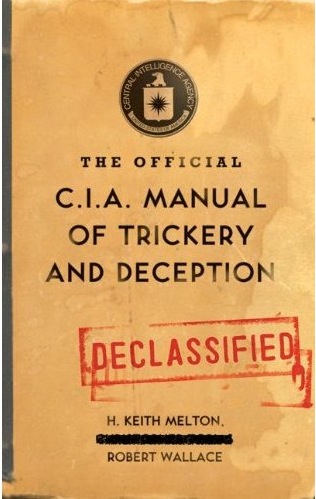
At the height of the Cold War, the Central Intelligence Agency paid $3,000 to renowned magician John Mulholland to write a manual on misdirection, concealment, and stagecraft. All known copies of the document — and a related paper, on conveying hidden signals — were believed to be destroyed in 1973. But recently, the manuals resurfaced, and have now been published as “The Official CIA Manual of Trickery and Deception.” Topics include working a clandestine partner, slipping a pill into the drink of the unsuspecting, and “surreptitious removal of objects by women.”
This wasn’t the first time a magician worked for a western government. Harry Houdini snooped on the German and the Russian militiaries for Scotland Yard. English illusionist Jasper Maskelyne is reported to created dummy submarines and fake tanks to distract Rommel’s army during World War II. Some reports even credit him with employing flashing lights to “hide” the Suez Canal.
But Mulholland’s contributions were far different, because they were part of a larger CIA effort, called MK-ULTRA, to control people’s minds. Which lead to the Agency’s infatuation with LSD, as David Hambling recounted here a few weeks ago: In the infamous Operation Midnight Climax, unwitting clients at CIA brothels in New York and San Francisco were slipped LSD and then monitored through one-way mirrors to see how they reacted. They even killed an elephant with LSD. Colleagues were also considered fair game for secret testing, to the point where a memo was issued instructing that the punch bowls at office Christmas parties were not to be spiked.
The *Boston Globe has put together a great visual summary of some of Mulholland’s best tricks for the CIA: the shoelace pattern that means “follow me”; the hidden compartment to smuggle in an agent; the best ways to appear dumb and non-threatening. Because there’s no better misdirection than appearing to be a fool. ---
Use your illusion: Among the CIA's many tricks during the Cold War, it turns out, was some actual magic. A now-declassified manual by magician John Mulholland taught American spies the arts of deceit.
When the Portuguese magician Luis de Matos made an elephant and a Ferrari disappear in front of 12,000 people in a Lisbon sports stadium for the Expo '98, when the Spaniard Mag Lari cut a person in eight pieces in his 2007 show Secrets, and when a magical chest spat fire, smoke and objects during a recent production at the Teatre Nacional de Catalunya, Carles Ferrandiz was never far away.
Read the rest of this article by By Kati Krause from the Wall Street Journal here.
David Blaine seems confident enough doing it, but how terrifying is it to try and make it as a street magician?
"What's your name?" barks the short, pugnacious man, addressing a member of his audience, who mumbles something back.
"You've got to speak up," he retorts, "you're not buying condoms." The man is Gazzo, a legend among street magicians, and at Cardiff's "School of Busking" he's teaching 20 would-be performers the arcane arts of attracting a crowd.
He marshals us, his spectators, moving us around to fill gaps in the crowd, while haranguing and bullying us. "Everyone take two steps backwards! Hands out of pockets: that's another game!"
Most of us here are amateur magicians, and some are captivated by the idea of making a living as a street performer. Gazzo tells us that you can make twice the average income from street magic but most people just love the thought of earning money from their hobby.
Tannen's Magic would like to congratulate Doug Edwards as he graces the cover of this month's Society of American Magicians M-U-M magazine. We honored Doug with our Louie Award in 2007. He has been a friend, customer, consultant and inspiration to our company for many decades. His Wonder Pen-A-Tration effect is the best selling trick in our eighty-four-year history. His Really Haunted effect in our New Stars of Magic series continues to be a top seller. We are pleased that he mentions his long association with our company and that we were totally instrumental in his growth to becoming a full fledged wand-wielder. The article contains a photo of Doug practicing the Zarrow shuffle at age 12. WOW!
This is an article from MAKE Magazinebrings the do-it-yourself mindset to all the technology in your life:
I love a good mystery. So does Wired Geekdad blogger and friend of MAKE, John Baichtal. In his words:
"A couple of months ago, I happened to catch the TED Talk given by Star Trek director J. J. Abrams concerning his love of mystery. The centerpiece of the talk was a simple cardboard box secured with packing tape and decorated with a giant question mark on one side. This box contains an assortment of magic tricks Abrams purchased from the Lou Tannen Magic Store as a kid, but for some reason, he's never opened it. For Abrams, the love of the mysterious unknown exceeds any value the magic tricks could provide."
Have you picked up the May issue of Wired magazine yet? You should, as guest-editor J.J. Abrams ("Alias," "Lost," "Fringe" and the upcoming Star Trek movie) has created a whole new experience in print. In addition to a puzzle buried inside, Abrams wrote an article on the magic of mystery - an article that talks about the immediacy of this Age and the ever-present spoiler.
"People often ask me how Lost is going to end. I usually tell them to ask Damon Lindelof and Carlton Cuse, who run that series. But I always wonder, do they really want to know? And what if I did tell them? They might have an aha moment, but without context. Especially since the final episode is a year away. That is to say, the experience—the setup for a joke's punch line, the buildup to a magic trick's big flourish—is as much of a thrill as the result. There's discovery to be made and wonder to be had on the journey that not only enrich the ending but in many ways define it."
You can read the full article here! You can read some of the other articles from the issue here as well.
J.J. Abrams, creative director Scott Dadich, deputy editor Thomas Goetz, and senior editor Chris Baker discuss the evolution of Wired's May issue.
Risto Pakarinen is a Finnish freelance writer, and an entrepreneur. He is a regular contributor to The Hockey News, nhl.com, and SAS's in-flight magazine Scanorama. His stories have appeared also in, for example, Fast Company, ESPN.com and ESPN The Magazine.
He has published two non-fiction books: Joukkue vailla vertaa, about Finland's first hockey world championship in May 2005, and Off the Post: hockey stories from across the world in November 2007. He is currently working on a Finnish translation of Ken Dryden's The Game.
He has just posted a blog at the nhl.com titled 'We All Have to Start Somewhere' where he talks about where some hockey players might intern. Here is what he says about Sidney Crosby of the Pittsburgh Penguins.
Sidney Crosby, intern at Tannen’s Magic Shop
“The world’s premier magic shop is pleased to announce the recruitment of Sidney Crosby as an unpaid intern through the Stanley Cup Playoffs in 2008. As intern, he will not be creating grand illusions, but he will be doing sleight-of-hand and other regular magic tricks.”
45 West 34th Street, Suite 608, New York, NY 10001, United States
Located in the heart of Midtown, in the Herald Square district of New York City, Tannen's Magic has been catering to the needs of professional and amateur magician's since 1925.




 Posts
Posts


